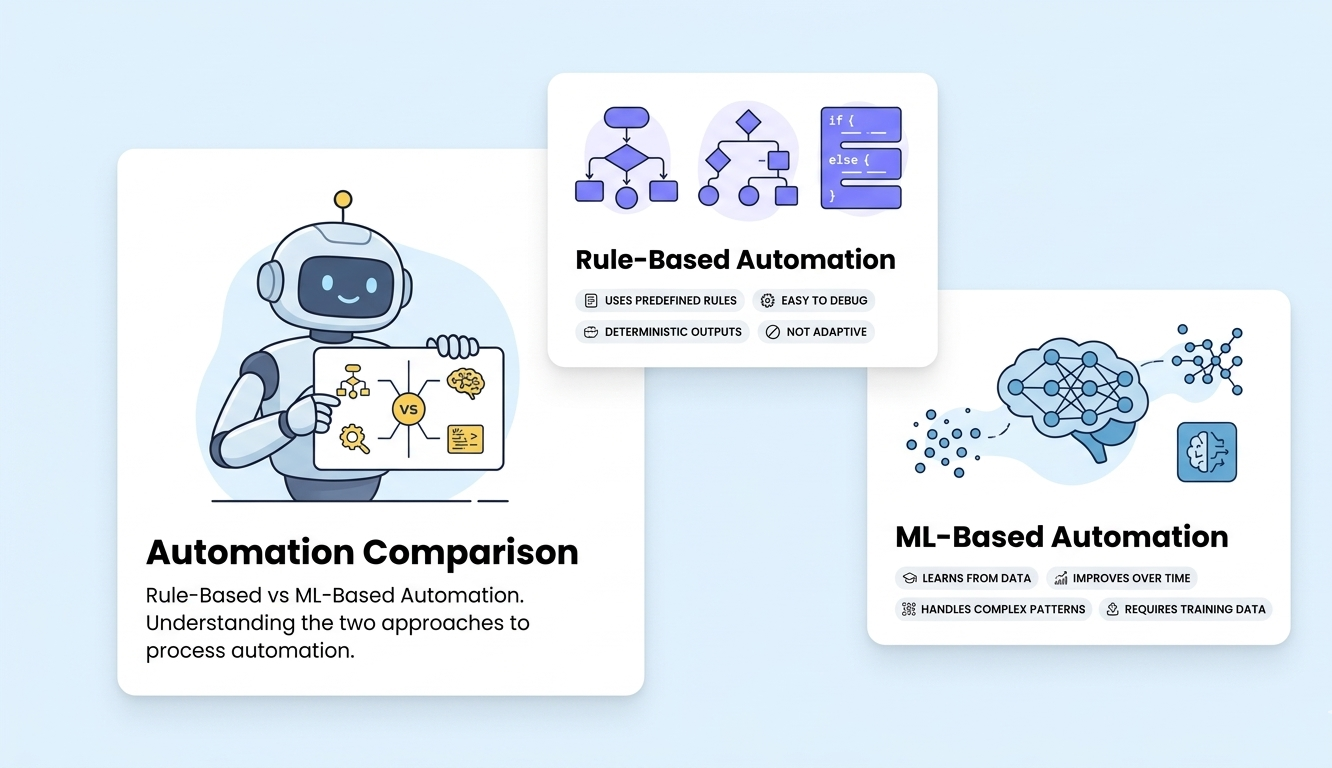
Rule-Based vs ML-Based Automation
Not every process needs machine learning. Understanding when to use rules vs ML can save you time, money, and headaches.
The hype around AI can make every automation challenge look like it needs machine learning. In reality, many business processes are better served by deterministic rule-based systems that are simpler, cheaper, and more predictable. Machine learning shines when the problem involves pattern recognition, natural language, or complex decision-making that cannot be captured in explicit rules. The key is matching the right approach to the right problem.
TL;DR
Use rule-based automation for well-defined, stable processes where accuracy must be 100%. Use ML-based automation when dealing with unstructured data, complex patterns, or decisions that require human-like judgment. Many successful systems combine both — rules for clear-cut cases, ML for ambiguous ones.
Overview
Rule-Based Automation
Deterministic systems that follow explicit if-then-else logic. Includes traditional RPA (Robotic Process Automation), workflow engines, and business rules management systems.
ML-Based Automation
Systems that learn patterns from data to make decisions. Includes classification models, NLP, computer vision, and LLM-powered workflows that handle ambiguity and unstructured data.
Head-to-Head Comparison
How Rule-Based Automation and ML-Based Automation stack up across key criteria.
| Criteria | Rule-Based Automation | ML-Based Automation |
|---|---|---|
| Predictability | Winner 100% deterministic — same input always produces same output | Probabilistic — outputs may vary; edge cases can be unpredictable |
| Handling Unstructured Data | Cannot process free text, images, or ambiguous inputs | Winner Excels at extracting meaning from text, images, and messy data |
| Implementation Speed | Winner Fast to implement for well-defined processes | Requires data collection, model training, and evaluation cycles |
| Maintenance Effort | Rules grow complex and brittle over time; edge cases multiply | Winner Models can improve with more data; retraining handles edge cases |
| Scalability to New Scenarios | Every new scenario requires new rules to be manually written | Winner Models generalize to new scenarios within the training distribution |
| Explainability | Winner Complete transparency — every decision can be traced to a specific rule | Decisions may be opaque; explainability tools add complexity |
| Error Handling | Winner Errors are predictable and typically fail loudly on unknown inputs | May produce confident but wrong answers on edge cases |
| Cost | Winner Lower development and infrastructure costs for simple processes | Higher initial investment but better ROI for complex processes |
Predictability
100% deterministic — same input always produces same output
Probabilistic — outputs may vary; edge cases can be unpredictable
Handling Unstructured Data
Cannot process free text, images, or ambiguous inputs
Excels at extracting meaning from text, images, and messy data
Implementation Speed
Fast to implement for well-defined processes
Requires data collection, model training, and evaluation cycles
Maintenance Effort
Rules grow complex and brittle over time; edge cases multiply
Models can improve with more data; retraining handles edge cases
Scalability to New Scenarios
Every new scenario requires new rules to be manually written
Models generalize to new scenarios within the training distribution
Explainability
Complete transparency — every decision can be traced to a specific rule
Decisions may be opaque; explainability tools add complexity
Error Handling
Errors are predictable and typically fail loudly on unknown inputs
May produce confident but wrong answers on edge cases
Cost
Lower development and infrastructure costs for simple processes
Higher initial investment but better ROI for complex processes
When to Use Each
Use Rule-Based Automation when...
- The process follows clear, well-documented business rules
- Regulatory compliance requires 100% explainable decisions
- Input data is structured and predictable (forms, databases, spreadsheets)
- The number of decision branches is manageable (under 50-100 rules)
- Errors must be deterministic — you need to guarantee specific outcomes
Use ML-Based Automation when...
- The process involves unstructured data like emails, documents, or images
- Decision logic is too complex or nuanced to express as explicit rules
- The number of edge cases makes rule maintenance unsustainable
- You want the system to improve over time with more data
- The process requires human-like judgment or pattern recognition
Our Recommendation
We often see the best results from a hybrid approach. Use rules for the clear-cut 80% of cases and ML for the ambiguous 20%. This gives you the determinism and explainability of rules where it matters, with the flexibility of ML where rules fall short. WebbyButter can audit your processes and recommend the optimal mix of rule-based and ML automation.
Automate Complex Business Processes with Confidence
Not every process needs AI. We help you identify where rules suffice and where ML delivers a competitive edge.
Process audit to identify high-ROI automation opportunities. Deterministic rule-based systems for 100% predictable outcomes. ML-powered workflows for handling unstructured data and ambiguity.
Frequently Asked Questions
Explore More
Related Resources
rag-systems for healthcare
Purpose-built rag systems solutions designed for the unique challenges of healthcare. We combine deep healthcare domain ...
Learn moreai-chatbots for healthcare
Purpose-built ai chatbots solutions designed for the unique challenges of healthcare. We combine deep healthcare domain ...
Learn moreAI Project Cost Calculator
Get a realistic estimate for your AI project based on type, complexity, team size, and timeline. No guesswork — just dat...
Learn moreAutomate Smarter, Not Harder
Our automation experts will analyze your processes and recommend the right mix of rule-based and ML-powered automation to maximize ROI and reliability.