Traditional vs AI Fraud Detection
Fraud evolves constantly. Compare how traditional and AI-powered systems stack up in the arms race against financial crime.
Financial fraud costs institutions billions annually, and the sophistication of attacks is accelerating. Traditional fraud detection relies on predefined rules and thresholds that analysts manually create and maintain. AI-powered fraud detection uses machine learning to identify patterns, anomalies, and emerging fraud typologies that rules cannot anticipate. The transition from rules to AI is well underway in financial services, but understanding the strengths and limitations of each approach is essential for building effective fraud prevention.
TL;DR
AI fraud detection catches 40-60% more fraud than rules alone while reducing false positives by 50-70%. Traditional rules remain important as a first line of defense for known fraud patterns. The most effective systems layer AI models on top of a rule-based foundation, combining the predictability of rules with the adaptability of machine learning.
Overview
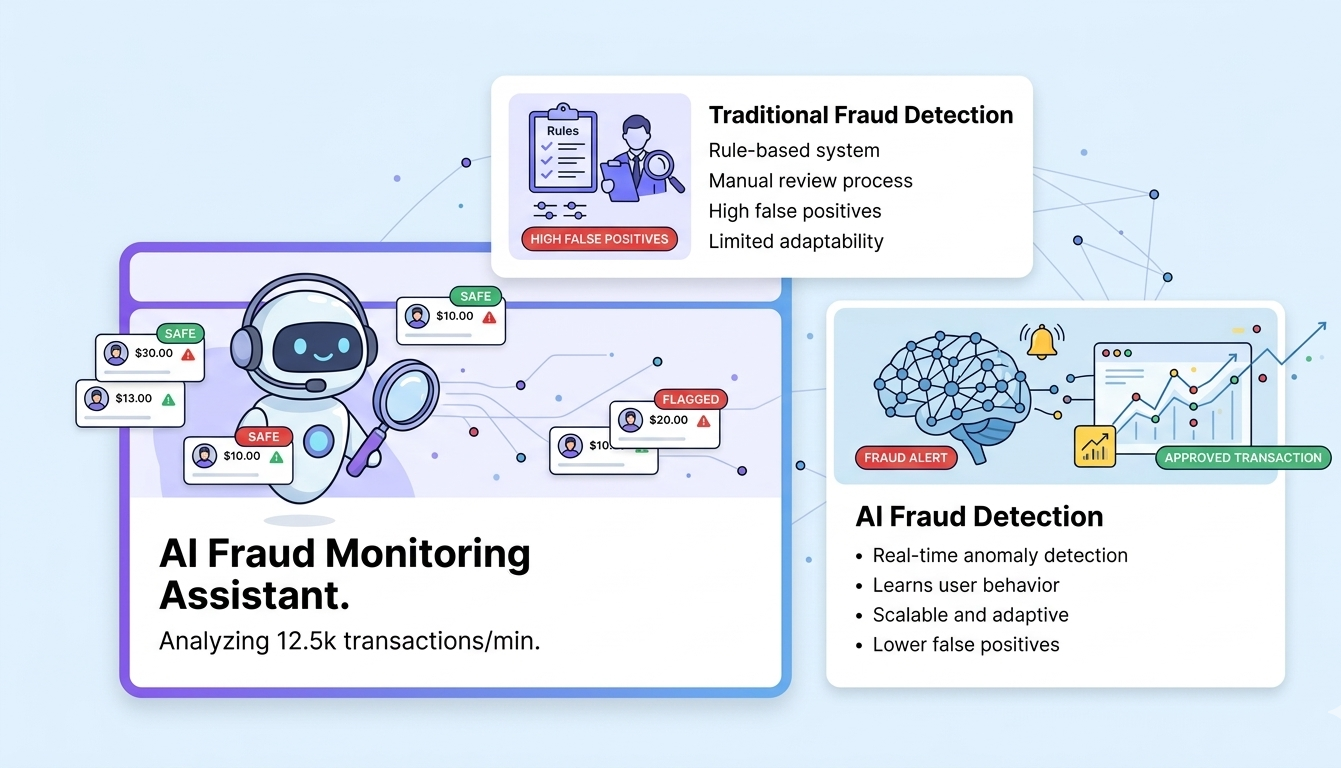
Traditional Fraud Detection
Rule-based systems with predefined thresholds, velocity checks, and pattern matching. Analysts manually create and update rules based on known fraud patterns and regulatory requirements.
AI Fraud Detection
Machine learning models trained on transaction data to identify fraudulent patterns, anomalies, and emerging attack vectors. Includes supervised models, unsupervised anomaly detection, and graph neural networks.
Head-to-Head Comparison
How Traditional Fraud Detection and AI Fraud Detection stack up across key criteria.
| Criteria | Traditional Fraud Detection | AI Fraud Detection |
|---|---|---|
| Detection Rate | Catches 50-70% of known fraud patterns | Winner Catches 85-95% of fraud including novel attack vectors |
| False Positive Rate | High false positive rates (5-10%) frustrate legitimate customers | Winner Reduces false positives by 50-70% through better pattern recognition |
| Adapting to New Fraud | Cannot detect novel fraud until analysts write new rules | Winner Anomaly detection identifies new patterns without explicit programming |
| Explainability | Winner Every alert traces to a specific rule; easy to explain to regulators | Model decisions require explainability tools; regulatory acceptance growing |
| Real-Time Processing | Rules execute quickly but may miss complex temporal patterns | ML inference runs in milliseconds; graph analysis may add latency |
| Maintenance Burden | Rule sets grow unwieldy; thousands of rules to maintain and tune | Winner Models retrain on new data; less manual intervention needed |
| Regulatory Compliance | Winner Rules directly map to regulatory requirements; auditors understand them | Regulators increasingly accept AI but require model governance frameworks |
| Cost of Implementation | Winner Lower initial setup cost using existing rule engines | Higher initial investment in data infrastructure and ML engineering |
Detection Rate
Catches 50-70% of known fraud patterns
Catches 85-95% of fraud including novel attack vectors
False Positive Rate
High false positive rates (5-10%) frustrate legitimate customers
Reduces false positives by 50-70% through better pattern recognition
Adapting to New Fraud
Cannot detect novel fraud until analysts write new rules
Anomaly detection identifies new patterns without explicit programming
Explainability
Every alert traces to a specific rule; easy to explain to regulators
Model decisions require explainability tools; regulatory acceptance growing
Real-Time Processing
Rules execute quickly but may miss complex temporal patterns
ML inference runs in milliseconds; graph analysis may add latency
Maintenance Burden
Rule sets grow unwieldy; thousands of rules to maintain and tune
Models retrain on new data; less manual intervention needed
Regulatory Compliance
Rules directly map to regulatory requirements; auditors understand them
Regulators increasingly accept AI but require model governance frameworks
Cost of Implementation
Lower initial setup cost using existing rule engines
Higher initial investment in data infrastructure and ML engineering
When to Use Each
Use Traditional Fraud Detection when...
- You need to comply with regulations that require explicitly defined rules
- Your fraud patterns are well-known and relatively stable
- Budget constraints limit investment in ML infrastructure
- Your organization lacks data science capabilities
- You need a quick deployment to address immediate fraud threats
Use AI Fraud Detection when...
- Fraud losses are growing despite existing rule-based defenses
- False positives are damaging customer experience and operational costs
- You face sophisticated, evolving attack vectors (synthetic identity, account takeover)
- You have sufficient historical transaction data to train models
- Real-time anomaly detection for new fraud patterns is critical
Our Recommendation
We strongly recommend a layered approach. Maintain rule-based systems for regulatory compliance and known fraud patterns as your first defense line. Layer ML models on top to catch what rules miss, reduce false positives, and adapt to emerging threats. This approach satisfies regulators while significantly improving detection. WebbyButter can build and deploy ML fraud detection models that integrate with your existing rule engines.
Stay Ahead of Evolving Fraud Patterns
Traditional rules are no longer enough. We build AI-powered detection that adapts to new threats in real-time.
40-60% improvement in detection rates for novel fraud typologies. Significant reduction in false positives to improve customer experience. Real-time anomaly detection for instant transaction authorization.
Frequently Asked Questions
Explore More
Related Resources
rag-systems for healthcare
Purpose-built rag systems solutions designed for the unique challenges of healthcare. We combine deep healthcare domain ...
Learn moreai-chatbots for healthcare
Purpose-built ai chatbots solutions designed for the unique challenges of healthcare. We combine deep healthcare domain ...
Learn moreAI Project Cost Calculator
Get a realistic estimate for your AI project based on type, complexity, team size, and timeline. No guesswork — just dat...
Learn moreUpgrade Your Fraud Detection
Catch more fraud with fewer false positives. Our ML engineers build fraud detection models that integrate with your existing infrastructure and satisfy regulatory requirements.